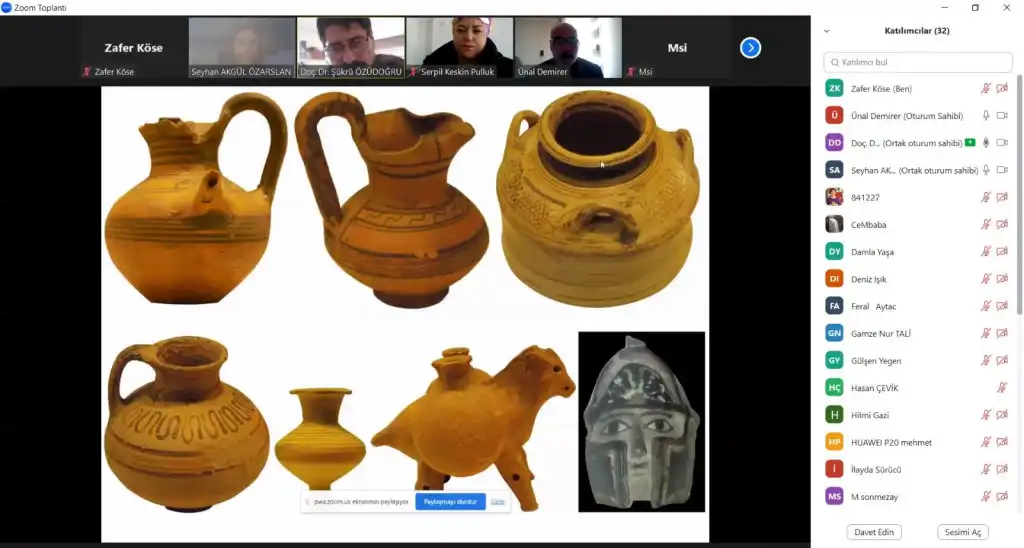

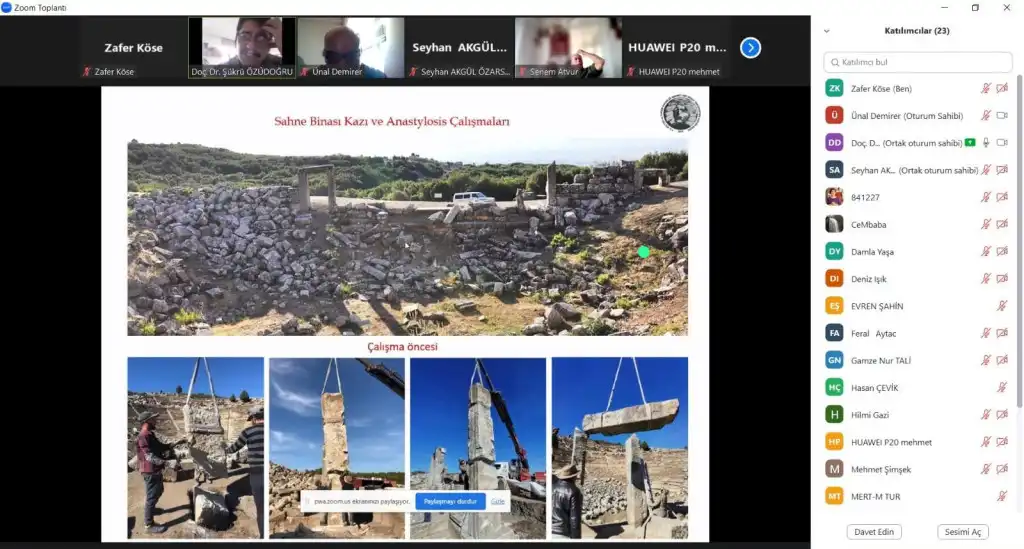
On Tuesday, March 21, 2023, at 15.00, an online (virtual) conference titled “Kibyra Excavation” was held by Assoc. Prof. Dr. Şükrü ÖZÜDOĞRU, a faculty member of our University’s Archaeology Department and the head of the Kibyra Excavation. Faculty members and our students attended the conference.

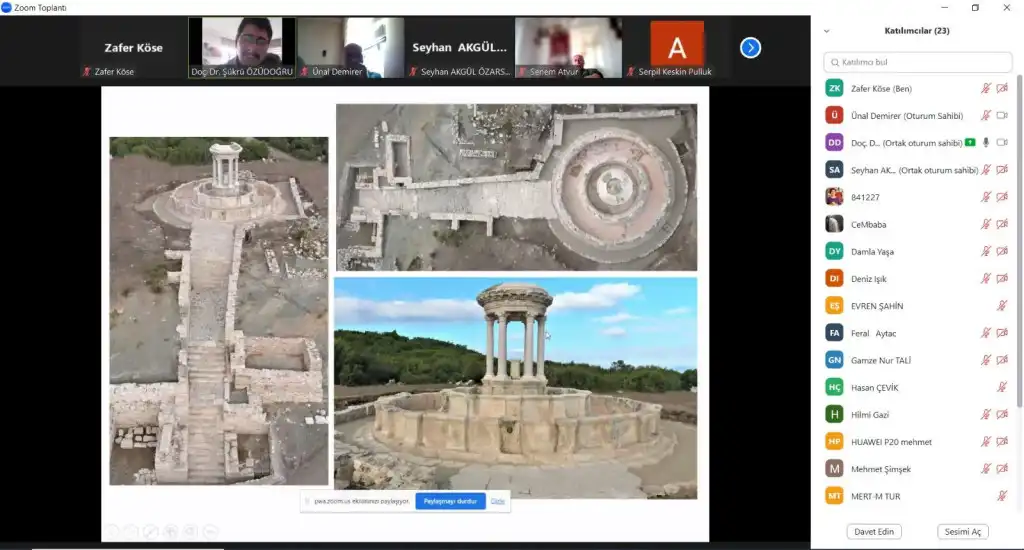
In the conference, Assoc. Prof. Dr. Şükrü ÖZÜDOĞRU gave a detailed presentation about the history, geographical structure, excavation, and restoration works of the ancient city of Kibyra.
Head of the Department of Architecture and Urban Planning, Assoc. Prof. Dr. Ünal DEMİRER, thanked the speaker Assoc. Prof. Dr. Şükrü ÖZÜDOĞRU for his presentation.
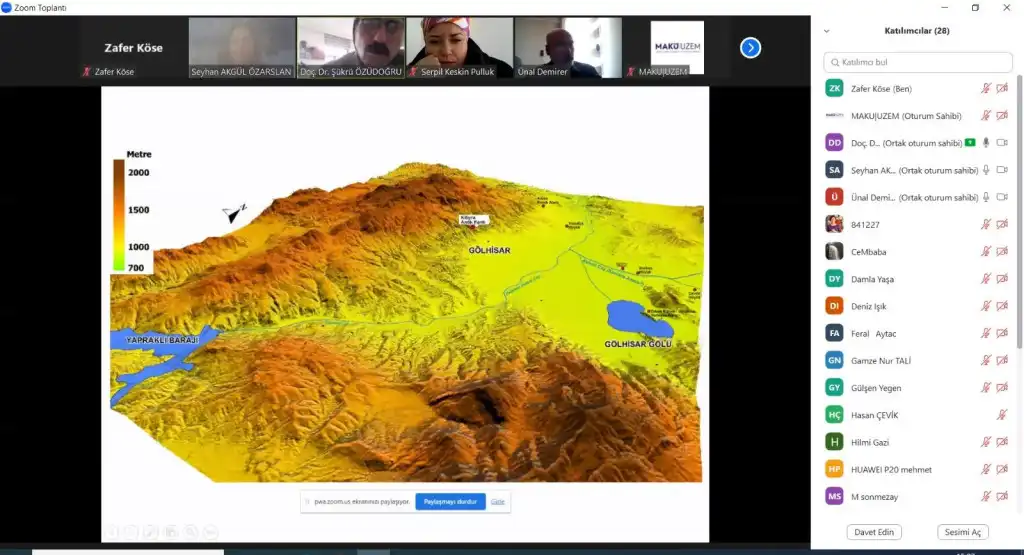
The ancient city of Kibyra is located on the low hills immediately west of the Gölhisar district. The settlement area of the ancient city of Kibyra is quite large. Kibyra sits on three dominant hills separated by deep ravines. The structures are symmetrically arranged, terraced on the hills with a view of the lake and plain, and no structure obstructs the view of another.
As you enter the city, you are greeted on the left by the magnificent monumental gate and the Kibyra Stadium, one of the most splendid and well-preserved ancient stadiums of Old Anatolia, with a capacity of 11,000 spectators. Here, you feel as if you are witnessing the struggles of gladiators. As you proceed, you encounter the Basilica, Upper and Lower Agora, Roman Bath, Gymnasium, Theater, and Odeion. On the other hand, the Monumental Tomb, Late Roman Bath, entrance gate with round towers, and ancient water channels will catch your interest. The excavation works, which started in 2006 under the leadership of the Burdur Museum, are currently being carried out by a team led by Assoc. Prof. Dr. Şükrü Özüdoğru, a faculty member of Mehmet Akif Ersoy University, on behalf of the T.C. Ministry of Culture and Tourism.
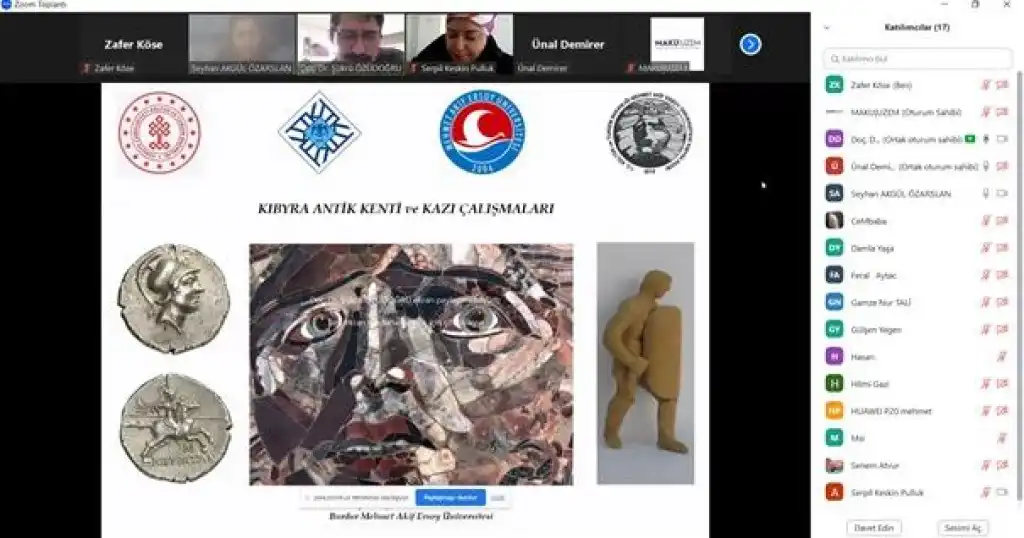
The Odeion (Music House), with a capacity of 3600 people, is the largest structure in our country that was covered with a roof in ancient times and is one of the most magnificent works with its interior decorations. The MEDUSA figure, with its hair made of snakes and its gaze that turns people to stone, made of red, green, and white marbles at the very center of the orchestra, is a unique example of its kind in terms of construction technique. In 2011, a mosaic covering an area of approximately 540 m2, which is the largest and most intact mosaic area in Anatolia, was uncovered in the Stoa in front of the Odeion. Again, in front of the Odeion, the Bath structure from the Late Roman Period (6th-7th centuries A.D.), with its sections, heating, and water systems, can be seen.
All the architectural remains visible in the city today belong to the Roman Imperial Period. In the Hellenistic Period, a quadruple “city union (Tetrapolis)” (2nd-1st centuries B.C.) was formed, consisting of Kibyra and the ancient cities of Boubon, Balboura, and Oinoanda located in its vicinity. This union of cities was dissolved and abolished by the Roman General Murena in 82 B.C. After this date, Kibyra was included in the Asia Province, and the other cities were included in the Lycian Union. In the Roman Imperial Period, it became the judicial center of the Asia Province Governor under the name “Kibyra Conventus,” to which approximately 25 cities were affiliated. The city, which was completely destroyed by a major earthquake in 23 A.D., was rebuilt with the tax exemption granted by the Roman Emperor Tiberius. Kibyra experienced its most brilliant and prosperous period especially in the 1st-3rd centuries A.D.
Kibyra is quite famous for its blacksmithing, leatherworking, and horse breeding. Pottery should also be added to this. The city’s people have a very warlike identity. The most striking works of the city are its magnificent Stadium, the opus sectile Medusa floor in the Odeion, and the largest and most intact mosaic area in Turkey in front of it. The artifacts unearthed from Kibyra are presented to the interest of visitors at the Burdur Museum.